S Words for Kids: 100+ Easy Words That Start With S
Looking for S words for kids? Some of the easiest S words to start with are sun, sit, sock, soap, sand, and six — and there are 100+ more below! I've sorted them from simple 3-letter words to S blends and bigger challenge words, so your child can practice one group at a time.
Are you new here? Hi! I’m Miss Beth, an early literacy specialist, founder of Big City Readers, and host of the Play on Words podcast. I know that children thrive with flexibility and a mix of activities, which is why I use the five building blocks of early literacy alongside the Orton-Gillingham method to make learning to read and write enjoyable.
S Words for Kids
Here are 100+ easy words that start with S, sorted from simple 3-letter words all the way up to S blends and bigger challenge words. Start at the top and work your way down as your child's confidence grows!
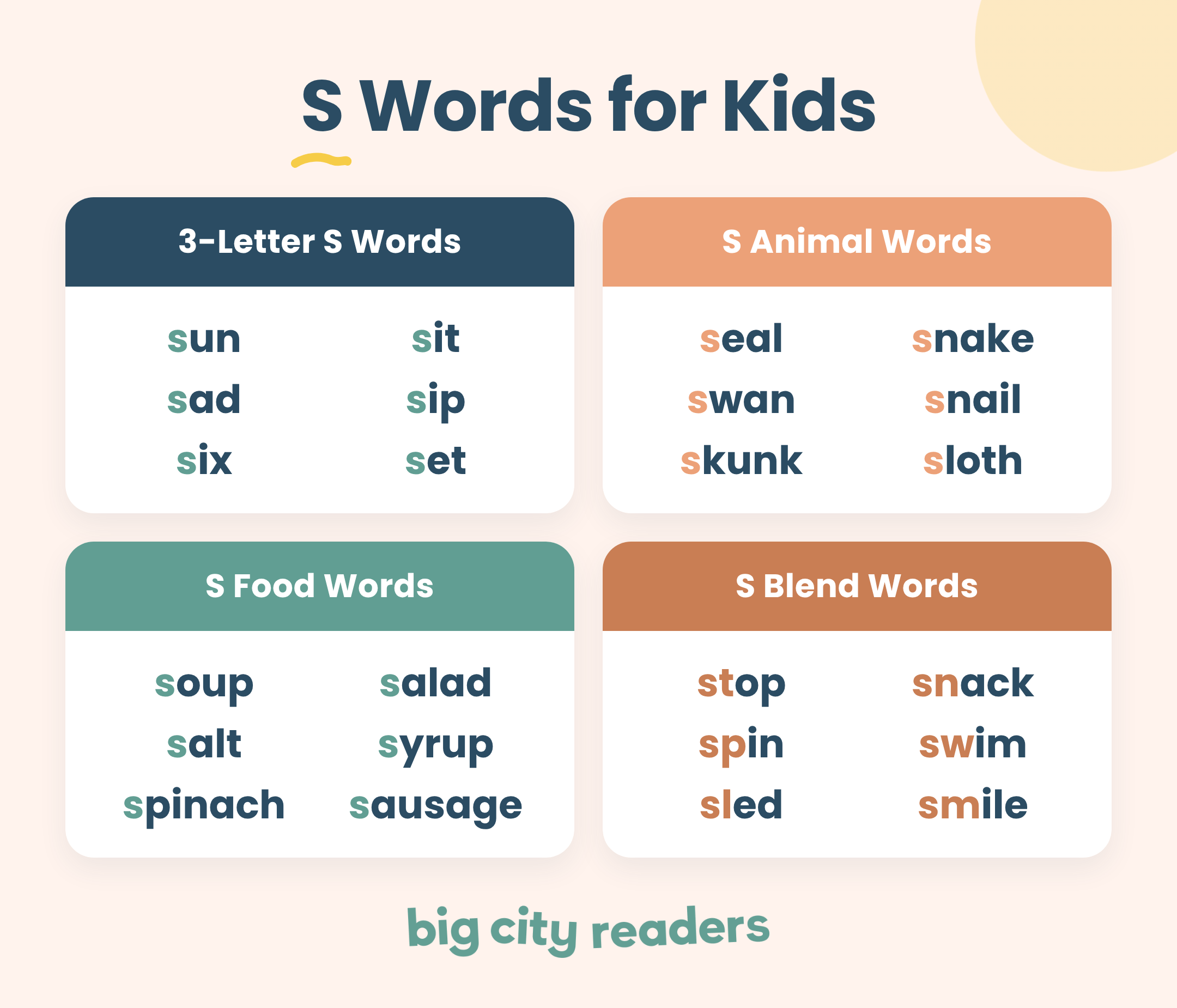
Easy 3-Letter S Words
sun
sit
sad
sip
sat
set
sub
sob
sap
sag
sum
six
S Words for Toddlers & Preschoolers
sock
soap
sand
sink
sofa
seat
sister
sing
silly
seven
sea
see
saw
say
S Animal Words
seal
snake
spider
squirrel
skunk
sloth
snail
swan
starfish
seahorse
salmon
sea lion
S Food Words
soup
salad
sandwich
salt
sausage
spaghetti
strawberry
spinach
sweet potato
smoothie
sprinkles
syrup
S Blend Words for Kindergarten
st: stop, star, step, stem, stick, still
sn: snap, sniff, snack, snow, snug
sp: spot, spin, spill, spell, spoon
sl: slip, slap, slam, sled, slide
sm: smell, smile, small, smog, smash
sw: swim, swing, sweep, swell, sweet
sk: skip, skin, skid, sky, skate
sc: scab, scan, scoop, score
Bigger S Words for Confident Readers
sunflower
sidewalk
submarine
superhero
surprise
seashell
saxophone
skeleton
sunglasses
suitcase
sandcastle
When S Sounds Like Z
Sometimes S makes a buzzy /z/ sound instead of /s/, especially in the middle or at the end of a word. Say these slowly with your child and listen for the "zzz"!
is
has
was
his
as
nose
rose
cheese
hose
busy
Why Teaching Both Vowels and Consonants Matters
When teaching your child the alphabet, balancing consonants and vowels is important. So often, I see parents focusing exclusively on vowels—which is great for your child’s development, but overlooks most of the alphabet! While vowels are foundational for building basic word structures, consonants like the letter S offer unique opportunities to enhance your child’s language skills.

Here are some of the reasons why I recommend teaching both together:
Boosts Vocabulary: The letter S is a versatile consonant found in many everyday words. Teaching S helps children expand their vocabulary by introducing both common and less familiar terms.
Encourages Phonemic Awareness: Consonants like S often require children to distinguish between similar sounds (e.g., “s” vs. “sh”), sharpening their ability to hear and produce different phonemes.
Builds Confidence: Because S appears in high-frequency words like “see,” “say,” and “sun,” mastering this letter can give your child an early sense of achievement.
If you’re curious to learn more about how phonemic awareness is the foundation for your child’s reading, check out my post: Phonological Awareness vs Phonics: What Is The Difference?
How to Teach the S Sound
S is one of my favorite letters to start with. You can stretch its sound out ("sssss") without it breaking apart, and that makes it great for early blending practice. Here's how to help your child hear it, say it, and use it in words.
What Sound Does S Make?
Most of the time, S makes a hissing /s/ sound, like a snake: "sssss." You'll hear it at the beginning of words like sun and sock, and at the end of words like bus and yes. Sometimes S makes a buzzy /z/ sound instead, like in is, has, and nose. Once your child is comfortable with /s/, that's a fun next step to explore together.
How to Make the S Sound
Show your child how to smile a little, bring their teeth close together, and keep their tongue tucked behind their top teeth. Then let the air hiss out like a slow, sneaky snake! A mirror helps a lot here, because little ones love watching their own mouths make the sound.
Fun Ways to Practice the S Sound
The best way to teach children letters (and anything for that matter) is through engaging and interactive ways. By incorporating playful activities into letter practice, you can help your child connect with the letter S in an enjoyable way that sparks their curiosity and enthusiasm for learning.
Here are some creative ideas you can try at home together!
Snake stretch: Stretch S words out slowly, like "sssss-uuuu-nnnn," then say them fast: sun! This is a simple way to practice blending.
S sound hunt: Walk around the house and collect things that start with /s/, like a sock, a spoon, soap, or a stuffed animal.
Snake or bee? Say pairs like bus and buzz or sip and zip, and have your child hiss for /s/ or buzz for /z/.
Sand writing: Have your child trace a big S in sand or salt while saying "sss." Seeing, saying, and moving at the same time is how the Orton-Gillingham approach helps new sounds stick.
Silly sentences: Make up tongue twisters together, like "Six silly seals sip soup on Saturday!"
When to Check In About a Lisp
Lots of young kids say "th" for S ("thun" for sun). That's a very common part of speech development, and many children grow out of it by about age 5.
If it's still going strong by kindergarten or first grade, or anything about their speech worries you, a quick check-in with a speech-language pathologist can give you peace of mind.
Are There Any Books That Focus on the Letter S?
Books are an excellent way to introduce new letters and sounds in an enjoyable and low-pressure way. Stories that feature the letter S can help your child recognize it in different contexts.
Here are a few recommendations for children’s books with the letter S:
“Q is for Duck: An Alphabet Guessing Game” by Michael Folsom: This is no ordinary alphabet book. Why is “Q” for “Duck”? Because a duck quacks, of course. Even the youngest readers will delight in the riddle-like text and lively, humorous illustrations. Now in vivid full color for the first time, this interactive treat is sure to be enjoyed by a whole new generation of readers.
“I See Summer” by Charles Ghigna: From lemonade in the shade to picnics in the park, summer is all around us. Spot the letter S all over this book!
“Slow Snail” by Mary Murphy: Snail is soooo slow! It takes her all day to slide down her flower, through a boot, under a stick, along a bottle, and in and out of a brick, trailing silver all the way. But when she finally arrives at her vegetable bed, it’s worth it — she’s just in time for dinner!
More Letter Word Lists for Kids
S is just one of the many letters your reader can have fun spotting, sounding out, and playing with! Keep building those letter-sound connections with more of our word lists:
Words That Start With A — Start at the beginning with easy A words kids can read, spell, and use.
Words With E — Explore E words and all the different sounds this busy little vowel can make.
Words With K — Practice spotting the letter K at the beginning, middle, and end of words.
Words That Start With Q — Get to know Q (and its best buddy U!) with kid-friendly words to practice together.
Words With U — Practice the long U sound with easy words kids can read, sort, and spell, like cube, mule, and flute.
Words With X — X can be a tricky one! See where it shows up in words and practice its different sounds.
Words With Y — Is it a consonant or a vowel? With Y, it can be both! Explore words that show kids how it works.
Words With Z — Hear how S's buzzy cousin Z makes the "zzz" sound, from zoo and zebra to buzz and pizza.
Make Letter Sounds Fun to Learn!

My new guide, The Complete Guide To The ABCs, is full of Miss Beth-approved worksheets, activities, video tutorials, tips, and more to help your child learn their ABCs and grow strong reading muscles. This includes 80+ pages of letter activities, downloads, and expert tips grounded in research-backed reading strategies and social-emotional development. And the best part? It’s FUN!
S Words FAQs
What Are Some Easy S Words for Kids?
Some of the easiest S words for kids are sun, sit, sock, soap, sand, and six. They're short, easy to sound out, and name things kids see every day. Start with these, then move on to S blends like stop and snack!
What Are Good S Words for Preschool?
Great S words for preschool are everyday words like sock, soap, sand, sink, sofa, and silly. Preschoolers learn best with things they can see and touch, so point out S words around the house and say the /s/ sound together.
What Sound Does the Letter S Make?
The letter S usually makes a hissing /s/ sound, like a snake: "sssss." Sometimes it makes a buzzy /z/ sound instead, like in is and has. Have your child hold a hand in front of their mouth to feel the air hiss out on /s/.
Why Does S Sometimes Sound Like Z?
S often sounds like Z in the middle or at the end of a word, like in is, has, was, and nose. It also happens when S makes a word plural, like dogs and bees. It's completely normal for this to feel tricky at first. Lots of listening practice helps kids hear the difference!
What Are S Blends?
S blends are two or three consonants that start with S, where you can still hear every sound, like st, sn, sp, sl, sm, sw, and sk. Words like stop, snack, spin, and swim are great practice once your child is comfortable with single-letter S words.
Is It Normal for My Child to Say "Th" Instead of "S"?
Yes, saying "th" for S is very common in young children, and many grow out of it by around age 5. If it hasn't faded by kindergarten or first grade, or you have any concerns, a speech-language pathologist can take a closer look and give you a plan.
Building a Foundation with Letters Like S
Teaching the letter S is a great step in expanding your child’s vocabulary and phonics skills. By incorporating books, games, and creative activities, you can make learning this versatile consonant an enjoyable and memorable experience. Most importantly, remember this experience should be fun, so take your time to teach individual letters with care and practice.
Do you have any questions about teaching consonants like S or tips of your own to share? Let me know in the comments! Don’t forget to check out my latest posts for more ideas to support your child’s early literacy journey here: