How Old Are Kids in Each Grade? A Parent’s Guide
"There's a range of normal. Age matters, yes, but it's only one piece of the picture."
How old are kids in each grade? It’s one of those questions that seems simple until you actually try to answer it. You hear different things from schools, other parents, social media, and even pediatricians, and suddenly you’re wondering if your child is ahead, behind, or where they should be.
Here’s what people never talk about: there’s a range of normal. Age matters, yes, but it’s only one piece of the picture. The more important part is how your child is developing socially, emotionally, and academically, especially when it comes to early reading skills.
If you’re new here, hi! I’m Miss Beth, the founder of Big City Readers. I help parents support early reading and writing through playful strategies rooted in the five building blocks of early literacy. My goal is to help families make sense of early learning decisions without fear or pressure. Today, we’ll walk through the typical ages for each grade and what you can expect.
Wait, So How Old Are Kids in Each Grade?
Before we dive into specific ages, it helps to zoom out for a moment. Schools use age cutoffs, but kids don’t all grow and develop on the same timeline. Two children of the same age can look very different when it comes to attention, reading readiness, and social skills.
This guide reflects the most common age ranges in the United States, but grade placement can vary depending on:
Birthday cut-off dates in your school district
Whether a child skips a grade or is given extra time
Social, emotional, or academic readiness
Individual development and learning pace
Age ranges are helpful for context, but they don’t define your child’s potential or progress.
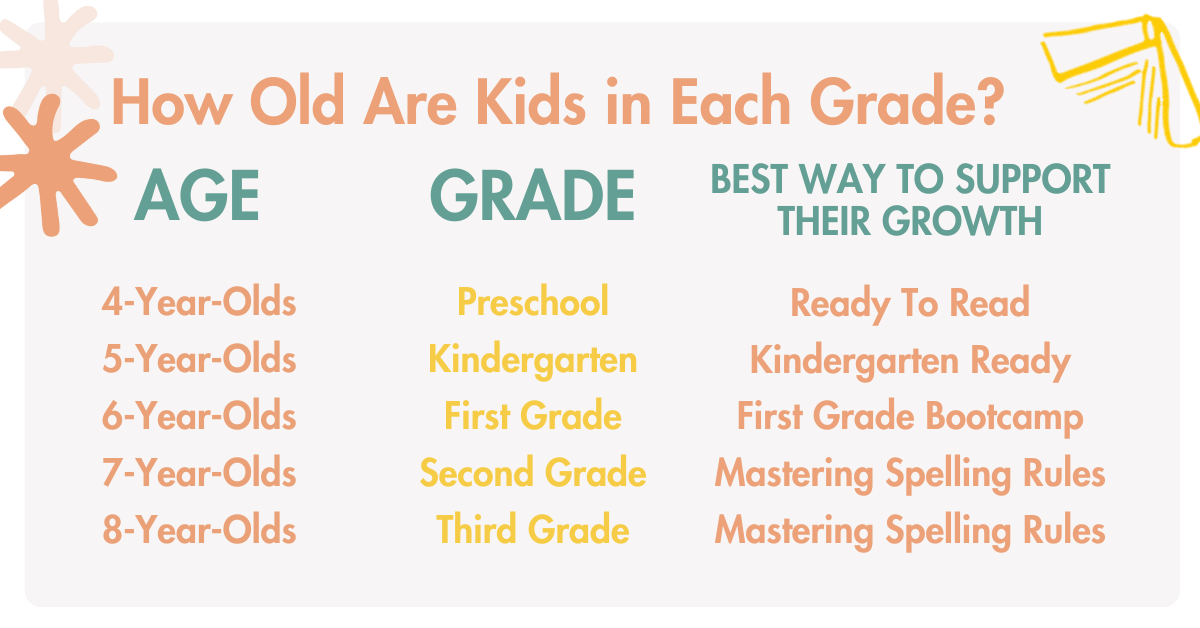
What Grade Are 4-Year-Olds?
Four-year-olds are usually in preschool, though that can look very different depending on the program. Some kids go a few days a week, others attend daily, and some stay home and learn through play. At this age, learning is happening constantly, even if it doesn’t look “academic.”
Preschoolers often build skills like:
Recognizing some letters and beginning sounds
Following simple directions
Engaging in imaginative and pretend play
Building oral language through conversation and stories
This stage is all about exposure and curiosity. Reading aloud, singing songs, and playing with language matter far more than worksheets.
If you’re looking for a gentle way to support early reading skills, Ready to Read introduces letter sounds and phonics through short, playful lessons that fit this age beautifully.
What Grade Are 5-Year-Olds?
By age five, many children are entering kindergarten, which is a huge transition. For many of them, it’s their first time being in school all day, following a structured routine, and being expected to learn in a group setting.
Kindergarteners are usually working toward:
Recognizing letter sounds and blending simple words
Beginning phonemic awareness skills like segmenting sounds
Writing their name and recognizing some familiar words
Understanding basic print concepts, like reading left to right
If you’re wondering whether your child is ready, keep in mind that readiness is about more than knowing letters. It’s also about confidence, stamina, and comfort with learning. My Kindergarten Ready course focuses on letter sounds, formation, blending, and early reading skills through 20 guided lessons designed to build confidence before the school year.
And if you’re not sure what your child should know by the end of kindergarten, I created a simple checklist to help you answer that question without overwhelm. It breaks down skills in a practical, reassuring way so you can feel confident supporting their learning at home.
What Grade Are 6-Year-Olds?
Six-year-olds are typically in first grade, which is where reading skills really start to solidify. Kids move from learning how reading works to using reading as a tool for learning.
At this stage, children are often developing:
Stronger phonemic awareness, including adding or removing sounds
Recognition of common digraphs like ch, sh, and th
Decoding simple words and sentences
Writing complete sentences and beginning short stories
If you’re unsure whether your child is on track for first grade, this is a great place to pause and check in. My What You Should Know in First Grade checklist clearly outlines the reading and writing skills most kids are developing at this stage, so you can spot potential gaps early.
This is also when confidence matters a lot. Kids who feel secure in their reading skills tend to take more risks and grow faster. My First Grade Bootcamp focuses on strengthening these foundational skills so kids feel capable and confident heading into first grade and beyond.
What Grade Are 7-Year-Olds?
By age seven, many kids are in second grade, and that’s when things really start to connect. Reading becomes smoother, spelling patterns become more noticeable, and writing starts to stretch beyond single sentences.
Second graders are often:
Recognizing and using complex vowel patterns
Decoding longer words with confidence
Reading fluently with expression
Writing short paragraphs and identifying main ideas
This is a big growth year, especially when reading, spelling, and writing begin to work together.
What Grade Are 8-Year-Olds?
Most 8-year-olds are in third grade, which is the school year that’s often described as a turning point. Kids are expected to read more independently and use reading to learn new content across subjects.
At this stage, children are typically:
Applying phonics to unfamiliar words
Learning prefixes and suffixes
Using context to figure out meaning
Writing more organized, detailed paragraphs
If your second or third-grader is struggling with spelling or decoding, Mastering Spelling Rules helps kids understand why words are spelled the way they are, which directly supports stronger reading and writing.
It’s Never Too Early to Support Reading Skills
Research consistently shows that reading becomes more challenging to remediate after third grade. That’s why supporting early literacy skills now makes such a difference long term. Simple activities like reading aloud together, talking about letters and sounds, and playing word games help more than most parents realize.
For a deeper look at what reading milestones to expect at each grade, check out our blog post on Reading Levels: Everything You Need to Know to Raise a Reader.
What Age Should Kids Start Preschool?
Most kids start preschool around ages 3 or 4, but readiness matters more than the number. Some children are eager for group learning early, while others benefit from more time at home.
Signs your child may be ready include:
Interest in books and stories
Ability to follow simple directions
Curiosity about letters or sounds
Comfort interacting with peers
Remember: preschool isn’t required, and it’s okay if your child’s path looks different.
What Is the Best Age to Start Kindergarten?
While age five is the typical age for starting kindergarten, the “best” age depends on your child. Pay attention to things like their emotional readiness, social skills, and early literacy development, not just their birthday.
If your child needs more time, Kindergarten Ready can help build confidence before their first day. On the other hand, if your kid is almost done with their kindergarten year and you’re not sure if they’re ready to move on, I wrote an entire blog post about what to expect in kindergarten and how to know if they’re ready for the next grade.
Have any questions about school start ages or grade placement? Feel free to DM me @bigcityreaders or leave a comment below! And for more early literacy support and learning tips, be sure to explore our other blogs: