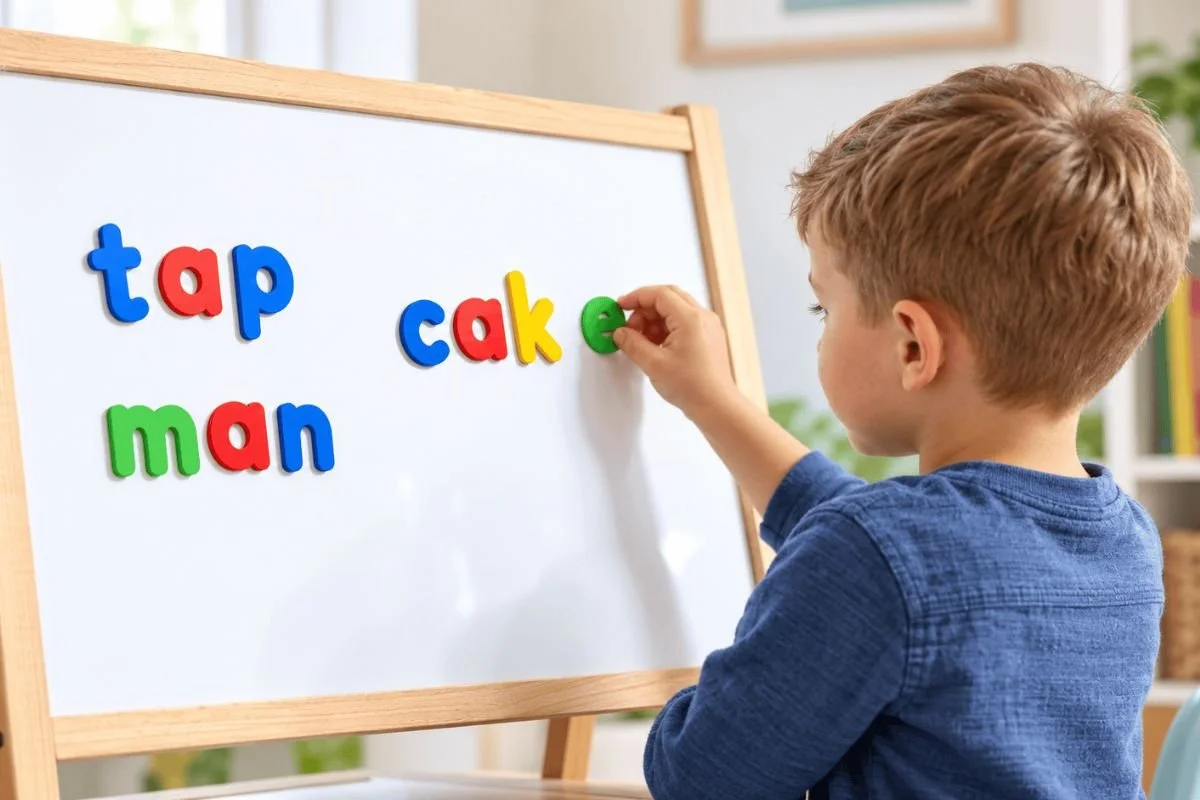
Long A words are a great example of how one little letter can completely change a word. Take cap and cape, for example. Add a silent E to the end, and just like that, the A says its name!
But silent E isn't the only way to make the long A sound /ā/. You'll also hear it in words like rain and play, which use different spelling patterns. Below, I've rounded up 100+ long A words organized by spelling pattern, along with fun activities to help your little reader practice at home.
If you're new here, hi! I'm Miss Beth, an early literacy specialist, the founder of Big City Readers, and host of the Play on Words podcast. I'm passionate about helping children build strong literacy foundations through playful, science-backed teaching methods.
Short A vs. Long A: What's the Difference?
Short A makes the /ă/ sound in cat, while long A makes the /ā/ sound in cake. When a vowel makes its long sound, it says its letter name!
One of my favorite ways to show kids the difference is by adding a silent E to the end of a short A word. Watch what happens when we add that one little letter:
| Short A | Long A (Silent E) |
|---|---|
| cap | cape |
| mad | made |
| tap | tape |
| can | cane |
| man | mane |
| hat | hate |
| plan | plane |
| Sam | Same |
| at | ate |
| pan | pane |

Pretty neat, right? The first vowel changes from its short sound to its long sound, even though we don't pronounce the E at the end.
For a hands-on demonstration, write cap on a piece of paper and have your child sound it out. Then add an E and ask them to read the new word, cape. Try a few more pairs together so they can hear how the vowel sound changes.
If your child is still working on short vowel sounds, you can also check out our Short Vowel Words for Kindergarteners and CVC Words for Beginning Readers blogs for more practice.
Long Vowel Words With A and Silent E
Long A silent E words follow the a_e spelling pattern, where an A is followed by a consonant and a silent E, as in cake, name, and gate. The E at the end helps the A make its long sound.
You might also hear this called Magic E or the VCe pattern. For a deeper explanation of how it works with all five vowels, check out our Silent E Rule Explained blog.
Here are some common long A silent E words organized by word family.
Long A Words Ending in -ake
bake, cake, lake, make, rake, take, wake, snake, shake, flake
Long A Words Ending in -ate
date, gate, late, plate, skate, crate, state, grate
Long A Words Ending in -ame
came, game, name, same, tame, frame, flame, blame
Long A Words Ending in -ade
made, fade, wade, shade, grade, trade, blade, spade
Long A Words Ending in -ave
cave, gave, save, wave, brave, crave
Long A Words Ending in -ace
face, lace, race, place, space, trace
Long A Words Ending in -ale
male, pale, sale, tale, whale, scale
Long A Words Ending in -ape
cape, tape, grape, shape, drape
Long A Words Ending in -ane
cane, lane, mane, plane, crane
Long A Words Ending in -age
cage, page, stage
| Spelling Pattern | Examples | Where You’ll See It |
|---|---|---|
| a_e (Silent E) | cake, name, gate | A followed by a consonant and silent E |
| AI | rain, mail, train | Usually in the middle of a word |
| AY | play, day, tray | Usually at the end of a word |
| EIGH / EI | eight, weigh, vein | Less common spelling patterns |
| EY | they, obey, prey | Another less common spelling |
| EA | great, break, steak | A less common sound for EA |
| Open Syllable A | baby, paper, apron | Long A at the end of an open syllable |
Miss Beth Tip: Start with a few words from the same family, like cake, lake, make, and take. Have your child read the first word, then change the beginning sound to make a new one. This helps them practice blending sounds while noticing familiar spelling patterns.
You can also build the words with magnetic letters or letter tiles so your child can physically swap out the beginning letters!
Long A Vowel Team Words (AI and AY)
The vowel teams AI and AY both make the long A sound /ā/, but they usually appear in different parts of a word.
A helpful spelling generalization is that AI usually comes in the middle of a word, while AY usually comes at the end. Think rain versus play!
Long A Words With AI
rain, train, paint, mail, tail, nail, sail, wait, snail, chain, brain, paid
Long A Words With AY
day, play, say, way, hay, may, clay, tray, stay, gray, spray, sway
When introducing these vowel teams, I like to write a few examples side by side so kids can see where the letters show up.
Try writing rain and play on a piece of paper. Ask your child to circle the two letters making the long A sound in each word. Then have them look at where those letters appear. Can they spot the pattern? This helps kids connect the sounds they hear with the spelling patterns they see!
More Ways to Spell the Long A Sound
Silent E, AI, and AY are some of the most common long A spelling patterns, but they're not the only ones! As your child becomes a more confident reader, they'll start encountering other ways to spell that same /ā/ sound.
These patterns are a little trickier, so there's no need to introduce them all at once. They're especially useful for children who have already mastered more common long vowel spellings.
Long A Words With EIGH and EI
eight, weigh, sleigh, neighbor, vein, reindeer
The letters EIGH and EI can work together to make the long A sound. You'll hear it in words like eight and weigh, even though there's no letter A in those words!
Long A Words With EY
they, hey, obey, prey
The EY spelling can also make the long A sound, as in they and obey. This is less common than AI or AY, but it's another pattern children will see in familiar words.
Long A Words With EA
great, break, steak
We often teach EA as the long E sound in words like team, but in a few words, it makes the long A sound instead.
Great, break, and steak are three helpful examples to practice together.
Long A Words With an Open Syllable
baby, paper, table, acorn, apron, bacon, lady, radio
An open syllable ends with a vowel, and that vowel often makes its long sound.
For example, the first syllable in baby is ba, which ends with the letter A. That's why the A says its name!
These words can be a little more challenging because they have more than one syllable. Try clapping the syllables together before reading the whole word.
Long A Words by Grade Level
Long A spelling patterns are introduced gradually as children build their phonics skills. Kindergarteners might start with simple silent E words, while first and second graders explore vowel teams and less common spelling patterns.
Here's a general guide to the types of long A words children may practice at each grade level:
| Grade Level | Long A Spelling Focus | Example Words |
|---|---|---|
| Kindergarten | Simple silent E (a_e) words | cake, game, name, gate, tape |
| First Grade | AI and AY vowel teams | rain, play, train, snail, tray |
| Second Grade | EIGH, EY, EA, and open syllables | eight, they, great, baby, paper |
Keep in mind that every phonics curriculum introduces skills in a slightly different order, and children progress at their own pace. It's best to start with spelling patterns your child has already been taught and build from there.
6 Fun Long A Games and Activities for Kids
Now let’s put those skills to use! These simple phonics games help kids recognize spelling patterns, blend sounds, and practice reading without needing a lesson plan.
Make a Magic E Wand: Write short A words like cap, tap, and mad on index cards. Attach a paper E to a craft stick, then have your child add it to each word and read how the vowel sound changes!
Sort Long A Words by Spelling Pattern: Create three groups labeled a_e, AI, and AY. Have your child read and sort words like cake, rain, and play into the correct groups.
Build a Long A Word Ladder: Start with cake, then change one letter at a time to make lake and lane. Add a letter to make plane! Have your child read each new word, using magnetic letters if you have them.
Roll and Read: Write six numbered rows of long A words. Have your child roll a die and read the matching row. Take turns to make it a game!
Go on a Long A Word Hunt: Grab a favorite book and search for long A words together. Have your child read each one and identify its spelling pattern.
Read Long A Practice Sentences: Try sentences like "Jake ate cake by the lake" or "The snail is late for the train." Have your child spot the long A words and identify their spelling patterns. Choose sentences that use phonics skills they've already learned.
Remember, a few minutes of focused practice is plenty, especially for younger readers!
Want to know why practicing spelling patterns makes such a BIG difference for early readers? Check out this episode of my Play on Words podcast, where I break down how kids learn to recognize words and why phonics is an essential part of building strong reading skills:
FAQs About Long A Words
What Is a Long A Word?
A long A word contains the /ā/ sound, where the vowel sounds like the letter name A. Examples include cake, rain, play, and eight. The sound can be spelled using several different letter patterns.
What Are the Different Ways to Spell Long A?
The most common long A spelling patterns are a_e (silent E), AI, and AY, as in cake, rain, and play. Other spellings include EIGH (eight), EY (they), EA (great), and open-syllable A (baby).
When Do You Use AI or AY?
AI usually appears in the middle of a word, like rain or mail, while AY usually appears at the end, like play or day. This is a helpful spelling generalization, although there are exceptions.
What's the Difference Between Short A and Long A?
Short A makes the /ă/ sound in cat, while long A makes the /ā/ sound in cake. Adding a silent E can change a short A word into a long A word, as in cap and cape.
Is "Have" a Long A Word?
No, have does not have the long A sound. The A makes its short vowel sound, even though the word ends in E. English words generally don't end in the letter V, so the E is needed for spelling rather than changing the vowel sound.
Keep Building Your Child's Phonics Skills
Learning to recognize long A spelling patterns helps children become more confident readers and spellers. Whether your child is just discovering Magic E or starting to tackle trickier vowel teams, practicing these patterns in words and sentences helps them apply what they're learning.
If your little reader is ready for more practice with spelling patterns, check out our Mastering Spelling Rules course! It's a great next step for building phonics and spelling skills with guided instruction and activities you can work through together at home.
Have questions about long vowel sounds or teaching phonics at home? Send me a DM at @bigcityreaders or leave a comment below. And be sure to explore our other blog posts for more reading and spelling activities to try with your little learner: