Prefixes and Suffixes for 2nd Graders: Word Lists + Easy Activities
One of my favorite things about teaching prefixes and suffixes for 2nd grade is showing kids how many words they can build from one they already know. While they’re learning words like unhappy and helpful, they’re also learning how the smaller parts inside a word can help them understand it.
When that starts to click, one word unlocks a whole bunch of new ones! Below, you'll find the most common prefixes and suffixes your 2nd grader should know, word lists you can practice together, and easy activities that make those new skills stick.
Jump to the full prefixes and suffixes word lists! ↓
If you’re new here, hi! I’m Miss Beth, an early literacy specialist, founder of Big City Readers, and host of the Play on Words podcast. I use the Science of Reading and play-based strategies to help kids become confident readers and give parents practical ways to support them at home.
Why Prefixes and Suffixes Matter in 2nd Grade
By 2nd grade, many kids are reading longer words and building a much bigger vocabulary. Learning common prefixes and suffixes gives them another tool for figuring out new words.
Take the word “help,” for example. If your child knows what help means AND learns that -ful means “full of,” they can use those meaningful word parts to understand what helpful means.
Now try “helpless.” Same base word, completely different meaning!
The more word parts kids recognize, the less they have to rely on memorizing words one at a time. They can decode bigger words in smaller parts and use the meaning of those parts to understand the whole word.
What Are Prefixes and Suffixes? A Kid-Friendly Explanation
A prefix is a group of letters added to the beginning of a word to change its meaning.
re + read = reread
If re- means “again,” then reread means to read again.
A suffix is a group of letters added to the end of a word. It can change the word's meaning or tell us something new about it.
help + ful = helpful
If -ful means “full of,” someone who is helpful is full of help!
Knowing prefixes and suffixes does not replace sounding out a word. It works alongside phonics. Kids can decode the parts of an unfamiliar word and then use what those meaningful parts tell them to understand the whole word, without guessing from a picture or the sentence.
When you're teaching prefixes and suffixes, don't stop at having your child identify the word part. Ask, “What does that tell us about the whole word?”
2nd Grade Prefix and Suffix Word List (With LOTS of Examples!)
Ready to start spotting word parts? These are some common prefixes and suffixes your second grader may see this year, along with plenty of examples you can read and talk about together.
Prefix UN-: “Not” or “Reverse an Action”
The prefix un- can have two common meanings. It can mean “not,” as in unhappy or unsafe. It can also mean “to reverse an action,” as in unlock, unpack, or untie.
Try these UN- prefix words:
happy → unhappy
kind → unkind
fair → unfair
safe → unsafe
lucky → unlucky
pack → unpack
lock → unlock
tie → untie
Help your child think about which meaning makes sense in each word. In unfair, un- means “not.” In unlock, it means to reverse the action of locking something.
Prefix RE-: “Again”
The prefix re- usually means “again.” This is an easy one to practice because kids hear RE- words all the time.
Try these RE- prefix words:
read → reread
play → replay
write → rewrite
do → redo
tell → retell
fill → refill
paint → repaint
build → rebuild
Once your child knows what re- means, see if they can explain a new word without your help. If re- means “again,” what could repaint mean?
Suffixes -FUL and -LESS
These two suffixes are especially fun to teach together because they can create opposite meanings.
-ful means “full of” or “having.”
-less means “without.”
Look at what happens when we start with the same base word:
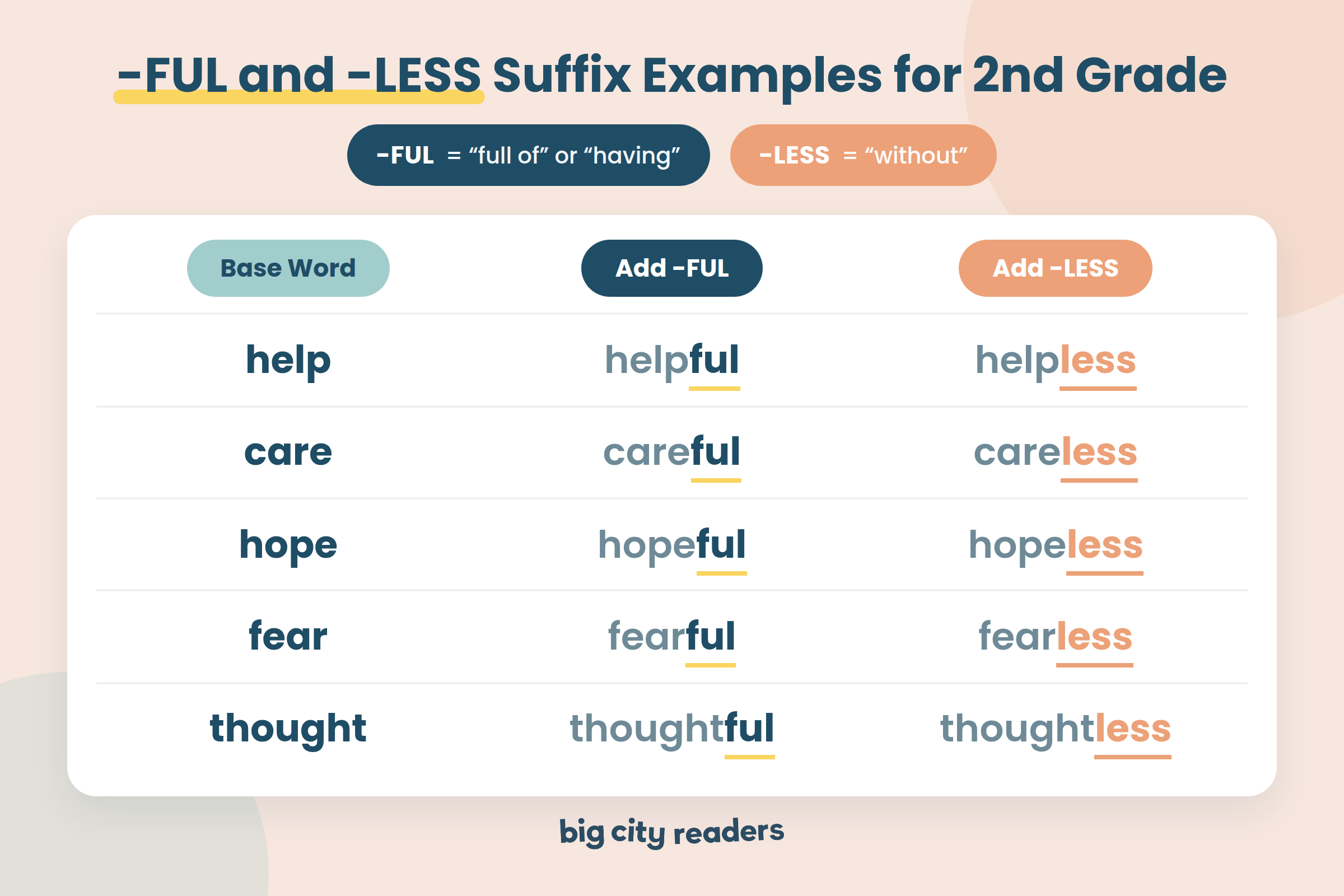
This is a great opportunity to show your child that they don't have to treat help, helpful, and helpless as three completely unrelated words. Find the part they already know first, then use the suffix to figure out what's changed.
Suffixes -ED and -ING
Your 2nd grader will also see -ed and -ing constantly in the books they're reading.
Adding -ed often tells us an action already happened:
jump → jumped
play → played
help → helped
paint → painted
Adding -ing often tells us an action is happening:
jump → jumping
play → playing
help → helping
paint → painting
You'll eventually notice that adding -ed and -ing can change the spelling of some base words. For now, focus on helping your child recognize the ending and think about what it's telling them about the word.
More Common Prefixes and Suffixes
Once un- and re- are clicking, your child can start noticing other common word parts, too.
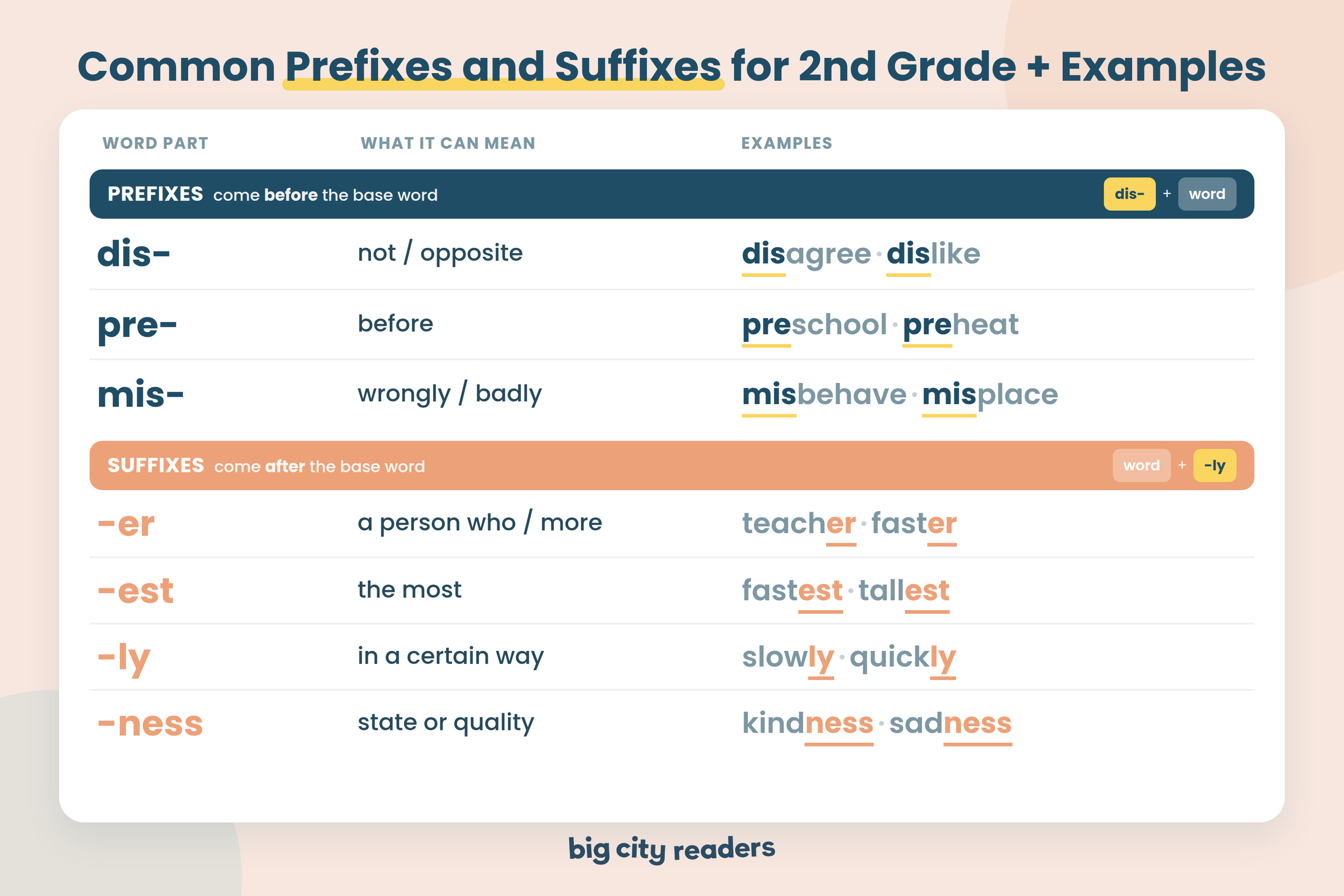
Don't worry about having your 2nd grader memorize every prefix and suffix on this list at once. Pick one or two, find them in words your child already knows, and start building from there.
We want them to eventually see a word like unkindness and think, “Hey! I know some of those parts!” That's when all this word work starts paying off.
Base Word vs. Root Word: Is There a Difference?
We hear “base word” and “root word” used interchangeably a lot when learning about prefixes and suffixes, but they aren't exactly the same thing.
A base word can stand on its own and still have meaning. For example, help is the base word in helpful, and kind is the base word in unkind. A root word is the core part of a word that carries meaning, but it doesn't always work as a word by itself.
For your 2nd grader, keep the focus on finding the familiar part first. If they see reread, can they spot read? If they see careless, can they find care? Finding the part they already know gives them a great place to start.
Easy Ways to Practice Prefixes and Suffixes With Your 2nd Grader
The more kids play with word parts and their meanings, the easier it gets to recognize them while reading.
Try a few of these at home:
Build a word. Write prefixes, base words, and suffixes on separate pieces of paper. Mix and match them to make words like un + kind, re + play, and help + ful. Then ask your child what their new word means.
Go on a word-part hunt. Grab the book your child is reading and look for words with prefixes and suffixes. How many un-, re-, -ed, or -ing words can they find?
Change the meaning. Start with a familiar word and give your child a challenge: “Can you turn happy into a word that means NOT happy?” Once unhappy is easy for them, try kind, safe, lock, or tie.
Play real word or silly word. Put together combinations like reread, unhappy, and uncat. Is it a real word? If it's not, what would it mean? The sillier the word, the better!
Build a word family. Start with one base word and see how many new words you can make. Help can become helpful, helpless, helper, and helped. Talk about what changed each time you added a new word part.
Not sure what to teach after prefixes and suffixes? My Mastering the Spelling Rules course is made for 2nd and 3rd graders who are ready to understand the patterns behind the words they read and spell. We cover prefixes, suffixes, syllables, vowel teams, and more in 20 engaging video lessons to help your child understand how words really work.
Prefixes and Suffixes for 2nd Grade FAQs
When Do Kids Learn Prefixes and Suffixes?
Prefixes and suffixes become an important focus in 2nd grade as kids learn to decode longer words and use familiar word parts to figure out meaning. They'll keep building on this skill for years as the words they read and spell get more complex.
What Prefixes Should a 2nd Grader Know?
Some common prefixes for 2nd graders include un-, re-, dis-, pre-, and mis-. Start with high-frequency prefixes like un- and re- and make sure your child understands what they mean, not just what they're called. Knowing that re- means “again” is what helps them make the jump from read to reread on their own.
What Suffixes Should a 2nd Grader Know?
Common suffixes for 2nd graders include -ed, -ing, -ful, -less, -er, -est, -ly, and -ness. Kids should begin recognizing these endings and understanding how adding one can change a base word.
Practice a few at a time and point them out when they pop up naturally in books and everyday words.
How Do Prefixes and Suffixes Help With Reading?
Prefixes and suffixes help kids understand unfamiliar words after they decode them. They can recognize meaningful word parts, like un- or -ful, and use what those parts mean to understand the whole word.
Keep Building Those BIG Word Skills!
Once your child starts looking for prefixes, suffixes, and base words, don't be surprised when they start pointing them out everywhere. Every new word part they learn gives them another tool for tackling unfamiliar words on their own.
Keep building words and talking about what those little pieces mean. The more word parts they recognize, the more confidently they can tackle new words. Pretty soon, those BIG words won’t feel so big anymore.
And if your 2nd grader is ready to take those skills even further, Mastering the Spelling Rules will help them learn the spelling patterns behind prefixes, suffixes, syllables, vowel teams, and more through step-by-step practice designed for growing readers. Happy learning!