Is Your Child's Reading Curriculum Science Based?
Reading is not something children pick up naturally the way they pick up spoken language. It has to be explicitly taught. And the curriculum your child's school uses shapes everything about how that teaching happens, whether it builds strong readers or leaves kids guessing their way through a book.
So how do you know which kind of program your school is using? Here is what to look for, what to watch out for, and the exact questions to ask at your next parent-teacher conference.
If you’re new here, hi! I’m Miss Beth, the founder of Big City Readers. As an early literacy specialist, I help parents and children turn learning to read into a fun experience through playful strategies rooted in the Science of Reading.
Two Very Different Approaches
There are two main philosophies schools use to teach reading: structured literacy and balanced literacy (sometimes called cueing). They are built on completely different ideas about how kids learn to read, and the difference matters more than most parents realize.
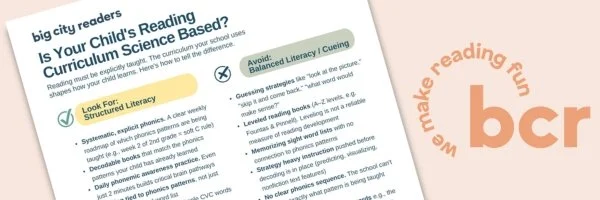
Download my cheat sheet by clicking the image above
Balanced Literacy and Cueing: What to Avoid
Balanced literacy leans on guessing strategies to help kids get through a word they don't know. You've probably heard some of these before:
"Look at the picture."
"Skip it and come back."
"What word would make sense?"
These strategies feel intuitive, and they can even help a child sound like they're reading. But they teach kids to guess at words instead of actually decoding them, which becomes a real problem once the pictures disappear and the vocabulary gets harder.
A few other signs your school may be leaning on balanced literacy:
Leveled reading books (A through Z levels, like Fountas & Pinnell). These leveling systems are popular, but leveling is not a reliable measure of how a child's reading skills are actually developing.
Memorizing sight word lists with no connection to phonics patterns. Kids end up memorizing shapes of words rather than learning how letters and sounds work together.
Strategy heavy instruction before decoding is solid. Things like predicting, visualizing, and studying nonfiction text features have their place, but not before a child can actually sound out words.
No clear phonics sequence. If you ask what pattern is being taught this week and the school can't tell you, that's a red flag.
Decodable books with words that aren't actually decodable. A kindergarten "decodable" reader that includes a word like "because" isn't really decodable at all.
A few programs known for leaning heavily on balanced literacy or cueing include Lucy Calkins' Units of Study, Fountas & Pinnell, and Benchmark Advance when it's paired with leveled readers.
Structured Literacy: What to Look For
Structured literacy takes the opposite approach. Instead of asking kids to guess, it teaches them to decode. It's explicit, systematic, and built on decades of reading research. Here's what it looks like in practice:
Systematic, explicit phonics. There's a clear weekly roadmap of what's being taught. For example, week two of second grade might focus on the soft C rule, and the teacher can tell you that without hesitation.
Decodable books that actually match what's been taught. If your child has learned short vowels and consonant blends, the books they're reading should only use words built from those patterns.
Daily phonemic awareness practice. Even two minutes a day builds critical brain pathways for reading.
Spelling tied to phonics patterns, not just a fixed list of words to memorize.
A gradual progression, moving from simple CVC words to blends, digraphs, silent-E, and eventually multisyllabic words.
Decoding comes first. Kids learn to sound out words before fluency strategies are layered on top.
Sound-letter relationships taught all the way through third grade. This goes well beyond the ABCs and includes digraphs like SH and suffixes like -TION.
3 Questions to Ask Your School
You don't need a background in reading science to figure out which approach your school is using. You just need to ask the right questions.
"What reading curriculum do you use? Is it structured literacy or balanced literacy?"
"How are children taught to approach a word they don't know? Do they decode it, or use picture clues?"
"Can you show me the phonics sequence? What pattern is being taught this week?"
A good school will welcome these questions. If they have a solid phonics curriculum in place, the answers will come easily.
And If the Curriculum Isn't There Yet?
You are not powerless here. Whatever your school's approach, you can support your child's decoding skills at home with the same structured, phonics based methods that the research supports with Big City Readers!
Questions about where to start? Email us at Hello@BigCityReaders.com. We're always happy to help. Send me a DM on Instagram @bigcityreaders or leave a comment below!